
As the Texas housing crisis evolves, so must our development strategies. For decades, the blueprint for affordable housing relied heavily on dense, mid-rise apartment complexes or three-story garden walkups. But today, a compelling alternative is emerging: nontraditional housing styles, including cottage-style communities, single-family build-to-rent (BTR), and townhomes.
At a recent TAAHP Local and Municipal Affairs (LAMA) chapter event in Dallas/Fort Worth, Kevin Wallace of Vision+ Architecture Studio moderated a panel of experts that included Alexa Abbott (Dominium), Blake Hopkins (Lincoln Avenue Properties), and Kyle Presley (Ojala Holdings) who discussed the design, operational, and financial nuances of this shift. The consensus? While developing these low-density, high-amenity communities presents unique hurdles, the market demand and long-term benefits are proving difficult to ignore.
The Cost of Breaking New Ground
Building horizontally rather than vertically changes the fundamental math of development. During the panel, experts noted that while supply chain issues have stabilized since the pandemic peak, constructing cottage-style or townhome communities remains roughly 15% to 20% more expensive than traditional apartment builds.
“These projects are more expensive, all else equal, than a three-story apartment,” noted Kirk Presley, Vice President of Investments with Ojala Partners.
Presley pointed out that hard costs for his firm’s recent cottage project reached $216 per square foot, whereas a traditional Federal Housing Tax Credit (LIHTC) development with a similar unit count currently averages around $150 to $155 per square foot.
The cost premium stems from sheer physics: more walls, more roofs, and vastly more infrastructure like paving and sidewalks. Site preparation is another critical variable.
Blake Hopkins with Lincoln Avenue Communities echoed this reality regarding his Dallas development. “This was a more expensive product,” Hopkins said. “I don’t think we realized how much more expensive per unit it would be.” His project encountered significant site-work expenses due to challenging topography and rock excavation—underscoring the absolute necessity of rigorous site analysis before breaking ground.
Three Case Studies in Innovation
Despite the elevated costs, developers are leveraging strategic public-private partnerships, housing tax credits, and property tax exemptions to make these deals pencil out. Three standout projects highlight the versatility of the model:
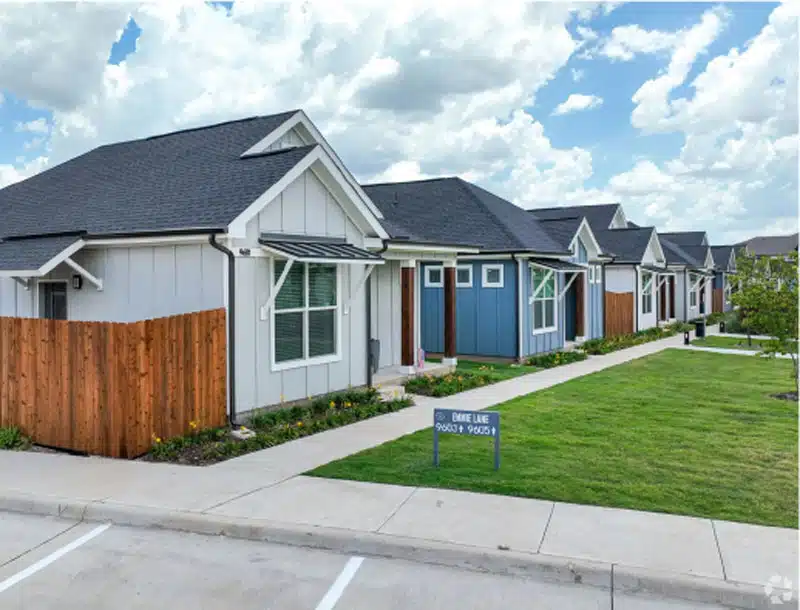
Skyline Prairie (Fort Worth):
Developed by Ojala Partners in collaboration with Fort Worth Housing Solutions, Skyline Prairie is a 236-unit development features single-story cottage and ranch-style rental homes. Although not LIHTC-funded, a Public Facility Corporation (PFC) structure and property tax exemption allow half the units to be rent- and income-restricted.
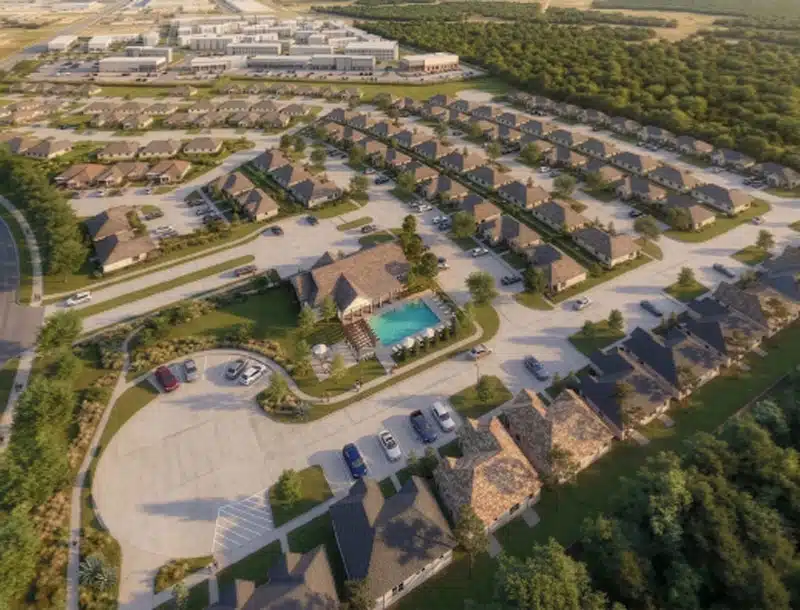
Westmoreland Senior Townhomes (Dallas):
Lincoln Avenue Communities recently broke ground on Westmoreland Senior Townhomes, a 216-unit LIHTC development. Built as single-story duplexes with one- and two-bedroom floorplans, the project serves seniors up to 60% AMI. A partnership with the Dallas Housing Finance Corporation, acting as bond issuer, provided the necessary property tax exemption.
Terrell Townhomes (Terrell):
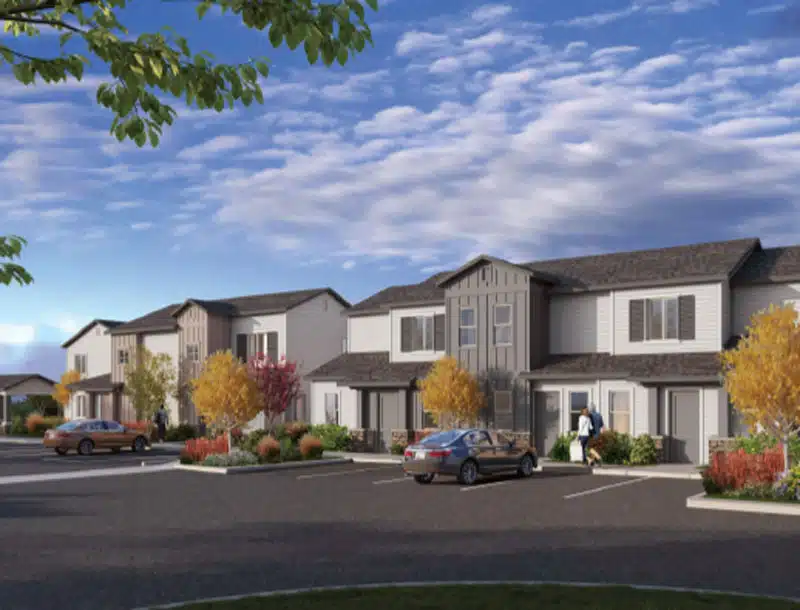
Dominium is delivering a sprawling 350-unit LIHTC community across 36 acres, featuring two-story duplexes with three- and four-bedroom floorplans. By partnering with the City of Terrell Housing Finance Corporation and securing a 30% basis boost from a Qualified Census Tract (QCT), the ambitious project was successfully underwritten.
The Retention Advantage
Why pursue a costlier product? In short: residents love it.
Market validation for BTR and cottage communities has exceeded expectations. Presley noted that the unique design choices allow market-rate units in these blended communities to significantly outperform nearby competitors. “People want the backyard, we have the little doggy door, you pull up and have a little parking spot next to your house,” he explained.
This preference translates directly into operational stability. Nontraditional affordable properties are seeing retention rates hovering around 70% after two years, a stark contrast to the 50% to 55% retention typically seen at standard apartment complexes. This “stickier” tenant base slashes turnover costs.
However, the single-family feel requires a different operational playbook. “We were really concerned about the maintenance cost of those backyards,” shared Alexa Abbott, Real Estate Development and Acquisitions Associate with Dominium. “We spent a lot of time thinking about the materials we were putting back there, the amount of landscaping.”
Growing Pains and Regulatory Hurdles
Because this product type is still relatively new to the affordable space, state agencies and local municipalities are playing catch-up.
“Tax credit BTR is not necessarily contemplated in the QAP in the way a three-story garden walkup building is,” Abbott noted, referencing TDHCA requirements. Issues around accessibility and visitability can force costly design revisions to meet standards initially written for traditional multifamily blocks.
Local zoning and permitting also remain massive bottlenecks. Time is money, and delays jeopardize project viability. “Everything could be faster, as we say, time kills deals,” added Hopkins.
Furthermore, state-level density solutions like SB 840—which permits multifamily development on commercially zoned land—often hit a wall at the local level. “I think the most impactful thing that can be done is doing away with RONOs [Resolutions of No Objection],” Abbott emphasized. “We can’t capitalize on SB 840 in the same way because we still have to get a RONO.”
The Legislative Threat: The ROAD to Housing Act
While local zoning poses daily challenges, a massive threat is looming at the federal level. The proposed 21st Century ROAD to Housing Act, currently advancing through the U.S. Senate, contains provisions aimed at curbing corporate ownership of single-family homes.
Under the bill’s current language, “large institutional investors”—defined as entities with investment control over 350 or more single-family homes—would face severe restrictions on acquiring new properties. While the legislation includes an exception for build-to-rent communities, it demands that investors divest and sell those homes to individual buyers within seven years.
For affordable housing developers relying on long-term tax credits, 15-year compliance periods, or perpetual affordability mandates, a forced 7-year divestment is fundamentally incompatible with their financing structures. Broadly written to target Wall Street speculators, the bill inadvertently threatens the viability of large-scale, cottage-style affordable housing.
TAAHP Executive Director Roger Arriaga captured the frustration of navigating such blunt legislative instruments: “This is extremely typical of what we have to deal with… how do you say we want our elected officials to support affordable housing, but we don’t want that bill, that’s where we get stuck in a box.”
Looking Forward
The transition toward nontraditional affordable housing represents a necessary and exciting evolution in the industry. As developers figure out how to scale cottage-style and BTR communities, they are successfully bridging the gap between traditional apartment living and the dream of a standalone home.
Unlocking this potential at scale, however, will require an aligned regulatory environment—one that recognizes the unique value of the product. As Presley aptly concluded, the industry needs systemic relief:
“We should look for tools that allow by-right development… let people build what the market is demanding on the land that’s there and don’t put artificial restrictions on every kind of development everywhere through all these different zoning codes.”