TDHCA’s mid-year scorecard, presented to the Governing Board on May 7, gives developers and stakeholders a clear-eyed look at how the agency’s largest production tool is performing — and where the pressure points are heading into Q3. Click here to read the full report.
A new scorecard
This quarter’s report debuts a parallel set of board-specific performance measures, handpicked by program staff and leadership to sit alongside the legacy measures TDHCA reports quarterly to the Legislative Budget Board. The new measures are paired with end-of-fiscal-year reviews for programs whose variances exceed a defined threshold, giving the board a more tailored view of agency performance. Performance data is also intended to feed into the TREO Regulatory Efficiency Review process, which positions this report as evidence for the regulatory and QAP conversations already underway.
Production is uneven across the two Housing Tax Credit programs
Through the first half of FY26, 9% new construction units came in ahead of schedule. Acquisition/rehabilitation is lagging, with the bulk of activity concentrated in 4% deals that cluster around the May 15 cost certification deadline. Expect a Q3 surge that will compress staff review capacity.
Table 1: HTC Unit Production, FY26 YTD
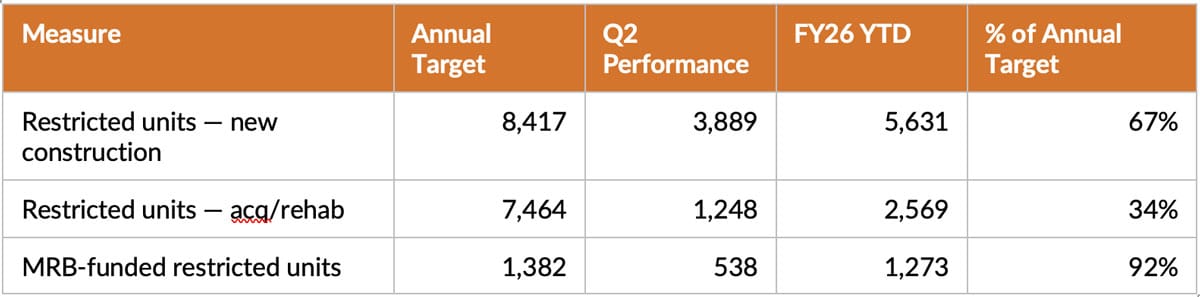
The 4% / MRB program is the production engine right now, tracking at 92% of annual target at the halfway point thanks to earlier-than-anticipated cost certification submissions.
Per-unit costs are running materially above target
Average annual credits per new-construction unit hit $16,145 in Q2 against a $12,229 target — a 32% overage. Staff attribute the variance to two factors: a significant number of 4% deals requesting increases to their original credit determinations due to construction and materials cost inflation, and several 9% deals receiving supplemental credits under provisions the board approved in the 2022 and 2023 QAPs.
Table 2: HTC Per-Unit Cost Trends
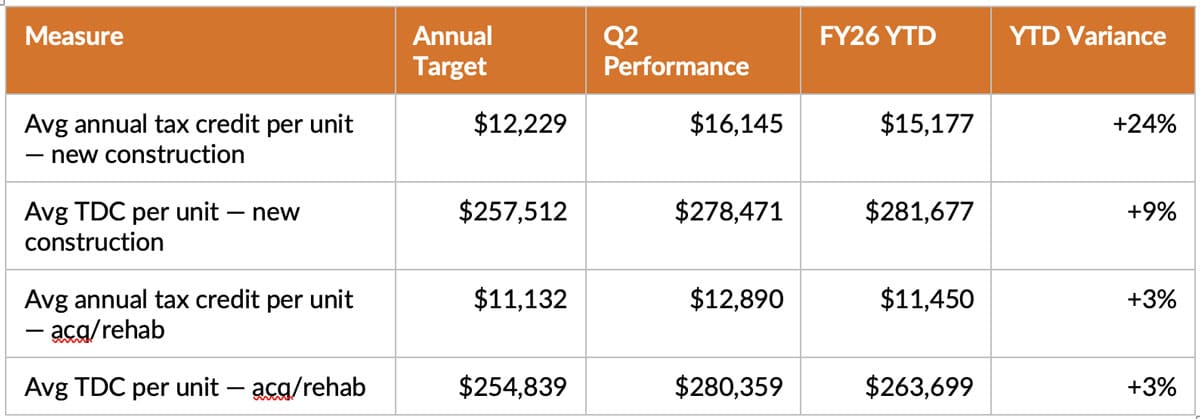
This is the supplemental framework working as designed — keeping awarded deals financially feasible through a construction cost environment that has not eased. It is also a reminder that FY26 targets were set against pre-inflation assumptions, and staff explicitly note per-unit credit amounts will remain elevated through Q3 and Q4. Under the board’s new posture on retargeting, that is exactly the kind of sustained variance that becomes the basis for a target reset rather than a recurring footnote.
Operational signals worth watching
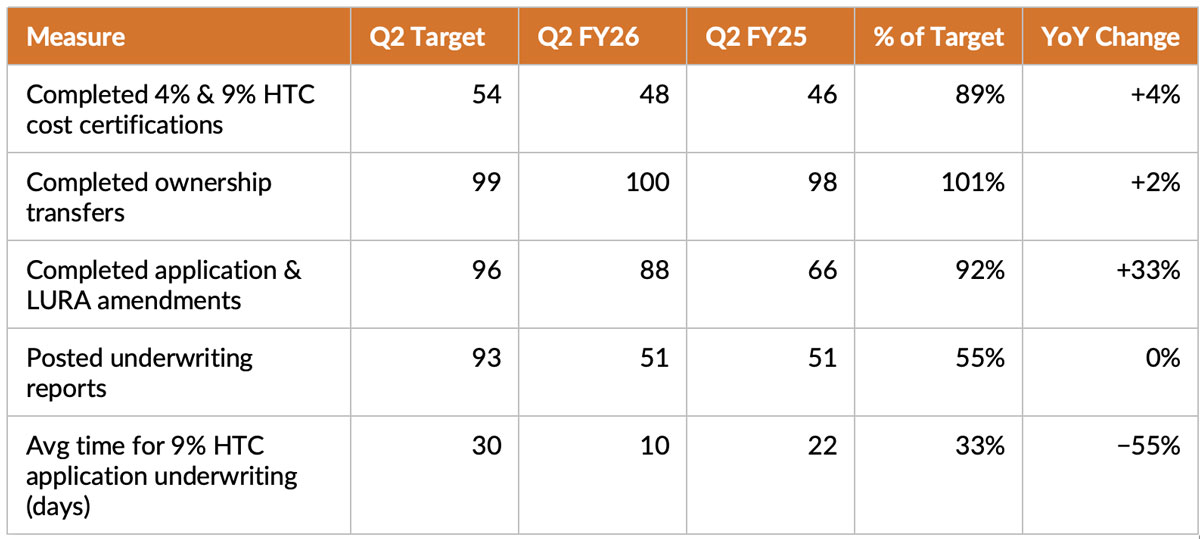
The new Board Performance Measures show staff capacity flowing toward managing existing-deal complexity rather than new deal flow. Application and LURA amendments are up 33% year-over-year — the operational footprint of cost pressure landing on staff as developers restructure deals mid-stream. Underwriting reports posted at 55% of Q2 target, even as the agency cut average 9% underwriting time to one-third of target.
Table 3: Multifamily Support Services — Board Performance Measures