
Written by Whitney Parra, TAAHP Senior Government Affairs Manager
The Texas Department of Housing and Community Affairs (TDHCA) is moving closer to adopting new immigration eligibility verification requirements for a subset of federally funded multifamily properties—an operational shift that owners and managers say will materially affect leasing, tenant files, recertification workflows, and compliance risk unless the final rule includes clearer limits and workable procedures.
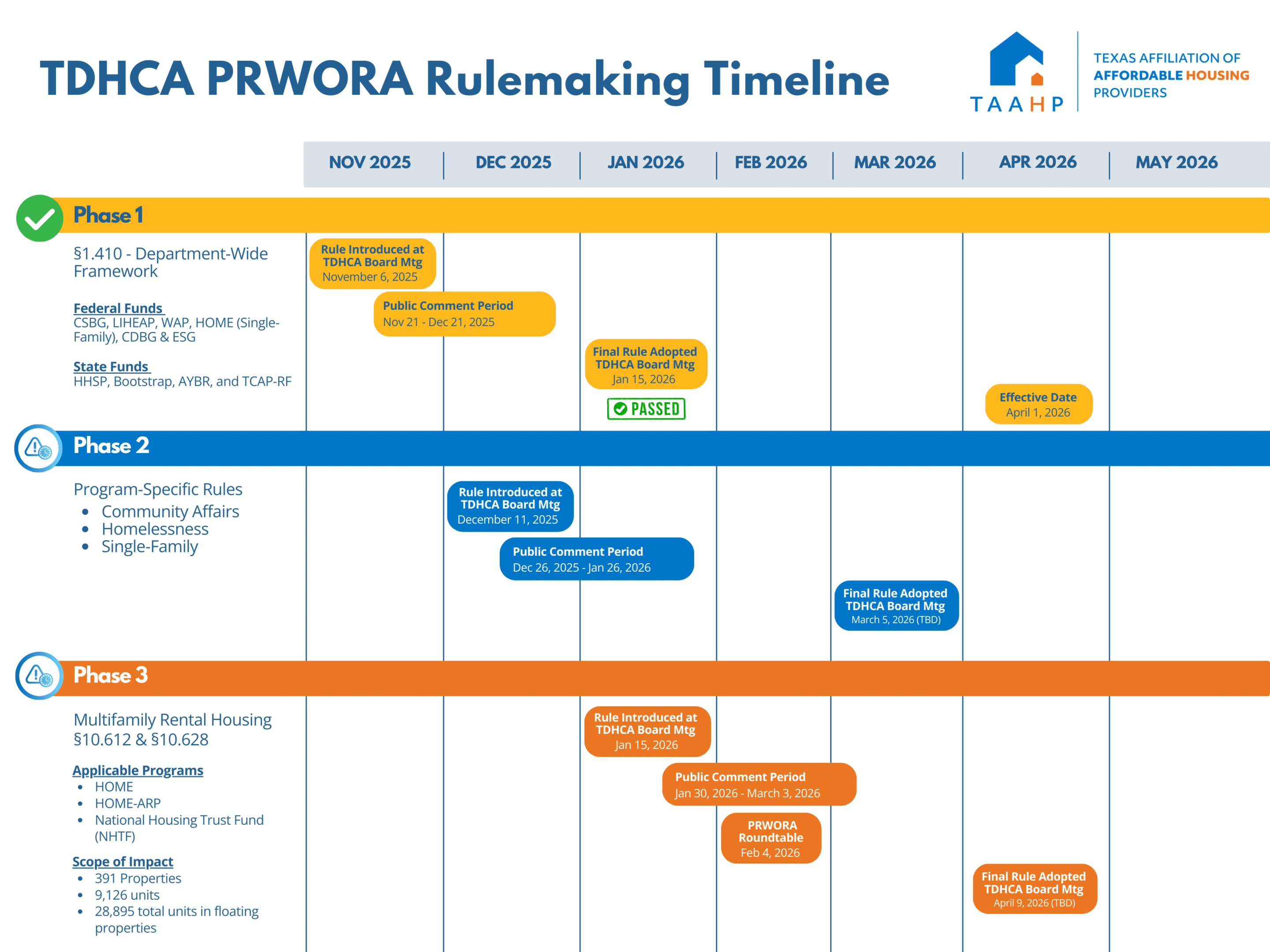
The TDHCA proposal would apply to developments financed with HOME, HOME-ARP Rental, or National Housing Trust Fund (NHTF) resources. TDHCA held an in-person stakeholder roundtable on February 4, will take additional public input at a virtual hearing on February 24, and is accepting written public comment through March 3.
What is driving this rulemaking? TDHCA is responding to federal PRWORA interpretations and grant compliance expectations that now treat additional HUD housing programs as covered “federal public benefits,” which in turn requires states and program operators to implement a workable verification process.
Federal Policy Basis: PRWORA and HUD Program Applicability
PRWORA—the Personal Responsibility and Work Opportunity Reconciliation Act of 1996—restricts access to certain “federal public benefits” based on immigration status. The statute does not provide a simple program-by-program list of covered benefits. Instead, applicability is determined through federal agency interpretations of what constitutes a covered “federal public benefit” within their program areas.
In late 2025, HUD published a Federal Register notice setting out its interpretation of “federal public benefit” under PRWORA and describing how HUD applies PRWORA across a wide range of HUD programs. In practical terms, that federal posture increases pressure on state agencies to ensure their HUD-funded programs—including multifamily programs like HOME, HOME-ARP Rental, and NHTF—have a defined, auditable eligibility verification process. TDHCA has framed its current rulemaking wave as Texas building that operational framework.
Why Texas Is Moving on PRWORA While Many Other States Aren’t
In August 2025, the case State of New York v. U.S. DOJ resulted in a court-filed stipulation in which the federal government agreed to temporarily pause enforcement and application of its new PRWORA “federal public benefit” interpretation in the plaintiff jurisdictions—a group that includes Washington, D.C. and 21 states. In those places, the practical effect was a court-driven hold, giving agencies less immediate pressure to operationalize the new interpretation in housing programs.
Texas is not a plaintiff jurisdiction. As a result, the federal notices were treated as effective immediately here, and TDHCA has moved to translate federal requirements into state-level operating rules, while many other states have been able to move more slowly or wait as litigation plays out.
TDHCA’s Phased Implementation Approach
TDHCA has implemented PRWORA through a staged rollout that separates service-style programs from rental housing operations.
- Phase 1: Department-Wide Framework. TDHCA adopted a department-wide framework rule establishing baseline applicability and verification structure across covered programs.
- Phase 2: Program-Specific Rules. TDHCA then translated the framework into program-by-program rules for Community Affairs, Homelessness, and Single-Family programs, clarifying who is verified, when verification occurs, and how certain household scenarios are handled.
- Phase 3: Multifamily Rental Housing (Current Proposal). The current proposal would establish verification timing, documentation, and monitoring expectations for multifamily developments with HOME, HOME-ARP Rental, or NHTF resources.
What the multifamily proposal would do
TDHCA is proposing a two-part rule package that would add new immigration-eligibility verification steps to the compliance files and workflows for properties with HOME, HOME-ARP Rental, or NHTF assistance.
- 10 TAC §10.612: Tenant file requirements
TDHCA would amend tenant file rules to require documentation demonstrating verification of legal status for lease signers and to add a lease-level attestation requirement where they confirm “they are not harboring an illegal immigrant in violation of federal law.” - New 10 TAC §10.628: Verification Process
A new section would set the verification process for covered properties, including when verification occurs and what must be retained to document compliance.
Properties affected
TDHCA has described the proposal as affecting 391 properties that have HOME, HOME-ARP Rental, or NHTF funding. Within those properties, TDHCA has identified 9,126 designated assisted units—the units tied to those funding sources.
However, TDHCA has also cited 28,895 total units because many of the affected properties use floating unit designations. In a floating structure, assisted status is not permanently tied to the same unit numbers, which means TDHCA’s draft “compliance environment” approach could extend verification expectations beyond the 9,126 designated units and into a much broader share of leasing activity at those properties. In other words, 9,126 reflects the assisted set-aside, but 28,895 reflects the potential operational footprint if floating units are treated as property-wide for compliance purposes.
Click here to view the discussion between TDHCA Staff and the Board about this proposed
rule and impact.
TAAHP Compliance Committee Engagement & Next Steps
TAAHP’s Compliance Committee is leading this work on behalf of the membership, coordinating closely with TAA and engaging TDHCA directly as the multifamily phase moves forward. The Committee has already participated in TDHCA’s implementation discussions—including the Feb. 4 stakeholder roundtable—and has been raising practical, file-level and leasing-office realities that will determine whether the final rule is administrable, consistent, and legally defensible.
TAAHP is also looping in additional stakeholders (operators, compliance professionals, and partner associations) to pressure-test the draft requirements and align comments where possible. We will continue to share updates as TDHCA releases draft forms, SAVE guidance, and monitoring expectations, and as the industry’s recommended guardrails take shape.
Stay tuned for additional member guidance and coordinated comment opportunities ahead of the March 3 deadline and the board adoption timeline.
Stay Connected: PRWORA Multifamily Rulemaking Survey
Please complete this short survey if your property uses HOME, HOME-ARP Rental, or NHTF funding, if you want timely updates as TDHCA releases draft forms, SAVE guidance, and monitoring expectations, or if you’d like to learn more about what’s coming.