
On March 3, TAAHP and the Texas Apartment Association (TAA) formally submitted a joint comment letter to TDHCA on its proposed PRWORA implementation rule for multifamily developments with HOME, HOME-ARP Rental, and National Housing Trust Fund (NHTF) units.
As discussed in our February newsletter, the proposal would create new immigration eligibility verification requirements for this subset of federally funded multifamily properties. This process has also moved faster in Texas than in many other states because of ongoing litigation over the federal PRWORA interpretation. In August 2025, a court-filed stipulation in State of New York v. U.S. DOJ temporarily paused enforcement of that interpretation in Washington, D.C. and 21 states. Because Texas is not a plaintiff jurisdiction, TDHCA has moved forward with state-level operating rules while many other states have been able to wait as litigation continues.
That made it especially important to engage the rule in detail. Although the current proposal does not apply to LIHTC units, similar verification requirements are beginning to emerge in other federal housing programs, making it essential to push for standards that are clear, workable, and practical to administer.
Three Highest-Priority Recommendations
1. Limit verification to assisted units, not entire properties.
TAAHP and TAA urged TDHCA to revise proposed §10.628(b) to make clear that PRWORA verification applies only to lease signers in HOME, HOME-ARP Rental, or NHTF assisted units. As drafted, the floating-unit language could instead be read to require screening across an entire property, not just assisted units. That would dramatically expand the rule’s scope from 9,126 assisted units in 391 affected developments to 28,895 units property-wide.
To quantify the workload impact, we used the same burden assumptions HUD applied in the Paperwork Reduction Act section of its recently proposed Section 214 verification rule. In that analysis, HUD estimates the staff time and labor cost associated with verification activities at 1.25 staff hours and $52 per response, or about $65 per verification event. These estimates are likely conservative because HUD’s burden framework is calculated on a per-person basis, while proposed §10.628 would apply to each lease signer, meaning total staff time and cost could increase substantially in households with multiple signers.
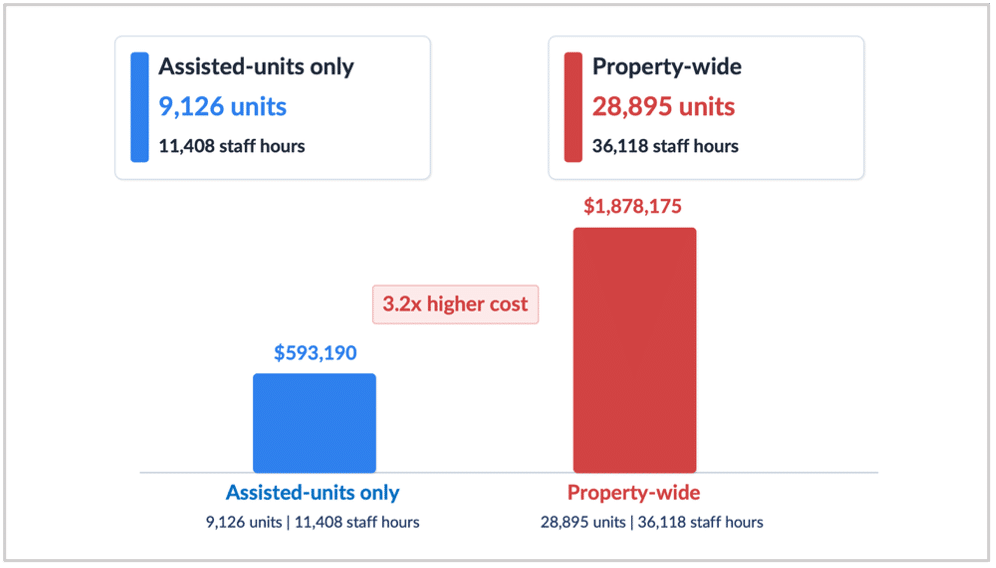
For that reason, our letter recommended amending §10.628(b) be amended to limit verification to lease signers in HOME, HOME-ARP Rental, and NHTF assisted units only. For developments using floating units, we further recommended that verification be required only when a specific unit is formally designated as assisted, with a clear audit trail in the tenant file showing the designated assisted unit, the effective date of that designation, and the household occupying the unit at that time (e.g. executed TIC).
2. Clarify timing, file standards, and delayed verification procedures
We also emphasized that the rule also needs much clearer standards for when verification is triggered, what must be retained in the file, and how delayed or inconclusive cases should be handled.
That concern is especially important because SAVE, the federal Systematic Alien Verification for Entitlements system used in this process, does not always return an immediate final answer. Some cases require follow-up review, secondary verification, or more time. HUD’s own proposed Section 214 framework anticipates that. Texas experience suggests caution here as well: in the voting context, the Texas Tribune reported that in 97 of 177 Texas counties that conducted follow-up review, more than 5 percent of people initially flagged by SAVE as noncitizens were later confirmed to be U.S. citizens. PRWORA verification is even more complex, because it can involve multiple eligible categories, including different forms of Qualified Alien status.
TAAHP and TAA therefore urged TDHCA to:
- clearly define when verification is required, especially for leases and renewals being processed before versus after the rule takes effect;
- replace vague “sufficient” documentation standards with method-specific transmittal and record-retention requirements; and
- adopt uniform statewide procedures for delayed, manual, or disputed results, including notices, timelines, extensions, and a compliance safe harbor when delays occur outside the owner’s control.
3. Amend the proposed “harboring” lease attestation
Our comments also advised TDHCA to replace the proposed requirement that residents certify they are not “harboring an illegal immigrant,” arguing that it introduces a vague criminal-law concept into a residential lease without a clear compliance standard. In practice, that leaves both residents and owners guessing how the language is supposed to apply. A resident could reasonably ask whether ordinary, lawful situations, such as allowing a babysitter into the unit, letting a child’s church friend stay overnight, or temporarily helping a neighbor during a family emergency, could somehow be questioned under that certification.
Instead, we recommended a narrower attestation tied directly to the verification process: lease signers would certify that the information and documentation submitted is true and complete, acknowledge the consequences of knowingly providing false information, and agree to notify the owner if lease signers change so any new signatory can be verified.
Broader Concerns About Cost, Consistency, and Government Expansion
Beyond those three priorities, TAAHP and TAA also encouraged TDHCA to take a harder look at the rule’s broader costs and implementation risks, contending that the current analyses understate the likely burden on both the Department and regulated properties.
Key concerns included:
- Higher compliance costs: fixed verification steps will be especially burdensome for small operators and rural properties with limited staff capacity
- Property and market impacts: added vacancies, turnover, and delayed lease-ups can weaken property performance and ripple outward into local housing markets
- Uneven rules can discourage participation: because the proposal would apply to TDHCA-monitored properties but not necessarily comparable locally administered properties, it could create an uneven playing field and make some owners less likely to pursue TDHCA resources over time.
What Comes Next
TDHCA is expected to take up the rule for final adoption at its April 9 Board meeting. Staff are expected to summarize the public comments received, walk the Board through any revisions, open the floor for one final round of public comment, and, if needed, make additional edits before the Board votes on the rule.