A new report from the RAND Center on Housing and Homelessness offers one of the clearest, data-backed explanations yet for why Texas stands out as a national leader in affordable housing production and why other states struggle to keep up.
Analyzing over 100 completed multifamily developments in Texas, California, and Colorado, the study aimed to answer a deceptively simple question: Why does it cost so much more to build housing in some states than others? Researchers controlled for variables like project size, building type, and financing method—then adjusted all costs to 2019 dollars to ensure apples-to-apples comparisons.
Their conclusion is as striking as it is validating: Texas consistently builds more affordably, more efficiently, and at greater scale than its peers.
Below, we break down the most important findings from the study and what they mean for housing policy in Texas and beyond.
Research Findings
- Texas is a national benchmark for affordability in housing production.
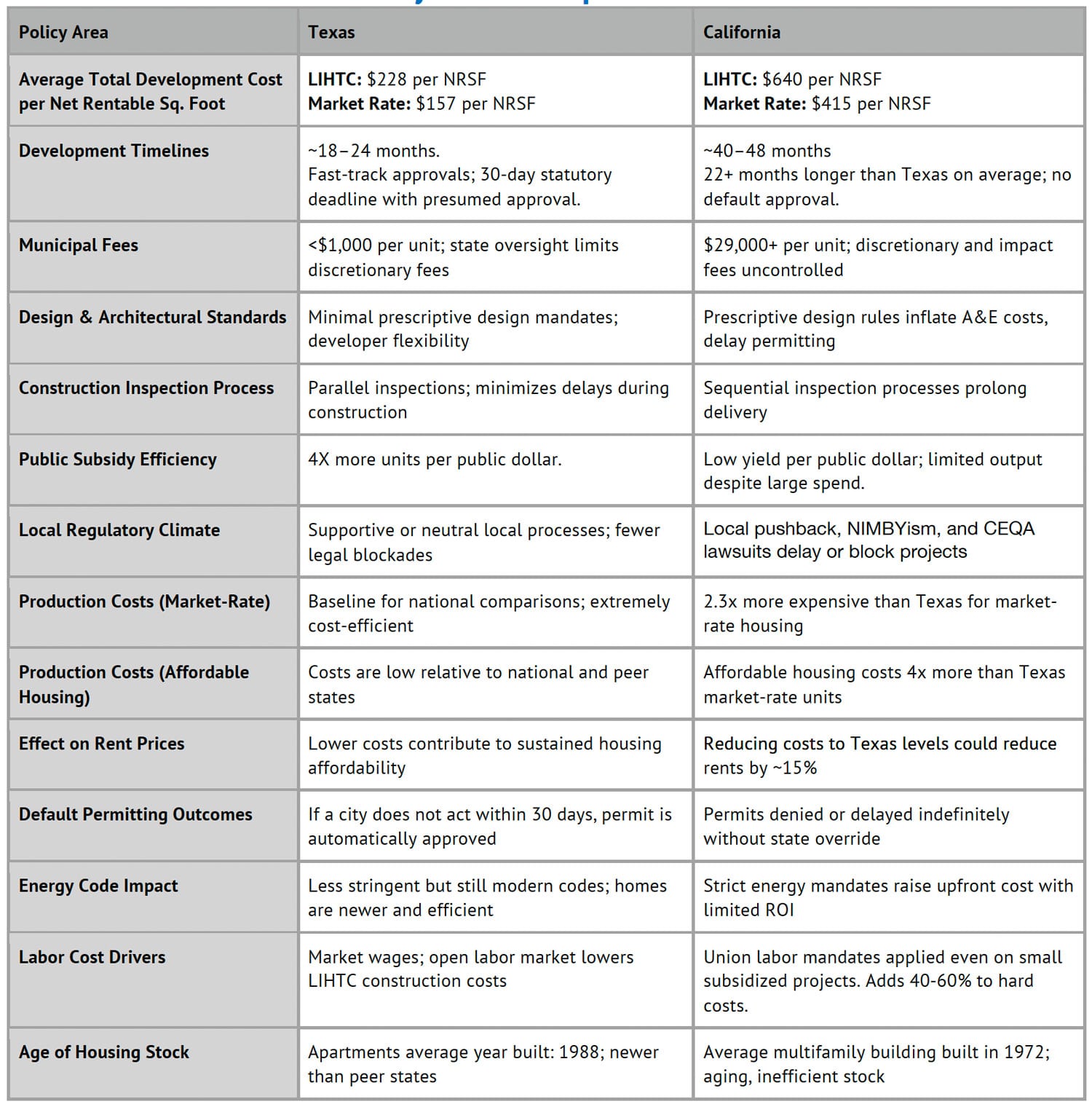
- Market-rate housing costs per square foot in Texas are less than half the national average—and less than one-fourth the cost of California’s publicly subsidized affordable housing.
- California’s affordable housing developments cost over four times more per unit than market-rate housing in Texas.
- Faster production timelines in Texas mean lower overall costs.
- On average, Texas projects are completed nearly two years faster than those in California.
- Shorter timelines reduce financing risk, labor escalation, and holding costs—making housing more viable for both developers and renters.
- Texas keeps fees low—dramatically lower than other states.
- Average municipal fees in Texas are under $1,000 per unit.
- By comparison, developers pay $12,000 per unit in Colorado and $29,000 in California—with some cities like San Diego exceeding $30,000.
- Texas avoids many the inflated soft costs that drive up prices elsewhere.
- Texas keeps soft costs relatively low at around $22 per square foot for market-rate developments and $60 for LIHTC. Compare that to California’s $84 and $187, respectively, and the compounding effect becomes clear.
- California’s higher costs are fueled by – above-market wage mandates for subsidized housing, extensive architectural/engineering requirements, and highly prescriptive design rules, especially in cities like Los Angeles and San Francisco.
- Texas’ regulatory environment enables scale and efficiency.
- Labor requirements explain 40 to 60 percent of the hard cost differential between Texas and California.
- Texas does not mandate union-level wages for most LIHTC projects, which helps keep labor costs more closely aligned with market norms.
- In California, by contrast, union wage mandates are applied across the board—even to small, 100-percent affordable projects—significantly increasing overall construction costs.
Texas as a Model—And a Caution
For states like California, the report offers a roadmap: streamline permitting, rein in fees, and recalibrate labor and design mandates. For Texas, the report serves as a reminder of what’s working—and what must be protected.
The very features that keep housing production efficient in Texas—predictable timelines, modest fees, and regulatory restraint—are often the most fragile in policy debates. As housing needs grow across the state, it’s critical that lawmakers avoid the temptation to import cost-inflating policies from elsewhere.
Texas has built a national model for scalable, affordable housing. This research affirms it. The challenge now is to keep it that way.
Texas vs. California: Side-by-Side Comparison