A new report from Enterprise Community Partners, Curbing the Insurance Spiral: Policy and Practitioner Strategies to Help Stabilize Multifamily Affordable Housing (February 2026) makes a clear and urgent case: the insurance crisis is rapidly becoming one of the most serious threats to the stability, preservation, and future production of affordable multifamily housing across the country.
While insurance affordability has received significant attention in the single-family market, the report makes clear that the same trend is having serious consequences for affordable rental housing. For multifamily owners and operators, insurance is becoming a larger and less predictable operating expense at the same time that other development and operating costs remain elevated.
Because the report is lengthy and detailed, TAAHP has summarized the key findings and takeaways most relevant to affordable housing providers, with particular attention to the Texas context. The overview below focuses on the report’s main risks, themes, and policy considerations.
Key Drivers of the Insurance Challenge
The report describes insurance costs as one of several compounding pressures affecting affordable housing providers, alongside rising interest rates, labor shortages, construction costs, and reduced public resources. In affordable housing, those pressures are especially difficult to absorb because properties operate under rent restrictions and tighter margins, leaving owners with far less flexibility than market-rate properties to offset rising insurance costs through rent growth.
The report points to several connected findings that help explain the problem:
- Premiums are rising sharply. Enterprise reports that 29 percent of housing providers experienced premium increases of 25 percent or more in 2023, with some seeing increases of 30 to 100 percent or higher.
- Providers are often paying more for less coverage. According to the report, rising costs are frequently paired with higher deductibles, more exclusions, and lower sub-limits, reducing the practical value of coverage even as premiums climb.
- Minimum coverage requirements limit flexibility. Lender, investor, and syndicator requirements often dictate minimum coverage levels, meaning providers cannot simply scale back coverage without affecting compliance or financing.
- Affordable multifamily properties often carry multiple layers of required coverage. Unlike a standard homeowners’ policy, affordable multifamily properties may require several types of insurance, sometimes from different insurers, including property, general liability, and specialized coverage such as flood, windstorm, or crime-related policies depending on location and financing requirements. As a result, providers are often facing rising costs across multiple required policies at once, even as coverage quality declines.
- Recent risk modeling changes are intensifying pressure in the Gulf and Southeast. The report highlights a 2023 update to Moody’s RMS North Atlantic Hurricane Model, described as the most significant revision in more than a decade. According to Enterprise, the update increased expected loss calculations by 10 to 20 percent overall, and by roughly 30 percent in the Gulf, Texas, Florida, and the broader Southeast.
Texas Disaster Exposure and Insurance Risk
The report’s findings are especially relevant for Texas because the state sits at the intersection of high affordable housing need and high exposure to costly weather-related events. For multifamily properties, that means insurance pricing is shaped not only by a property’s individual condition or claims history, but also by how insurers and reinsurers view the broader catastrophe risk associated with Texas and the Gulf region.
The graphic below shows the 27 separate billion-dollar weather and climate disasters recorded across the United States in 2024. It is useful because it illustrates both the frequency of major events and the range of disaster types affecting different parts of the country.
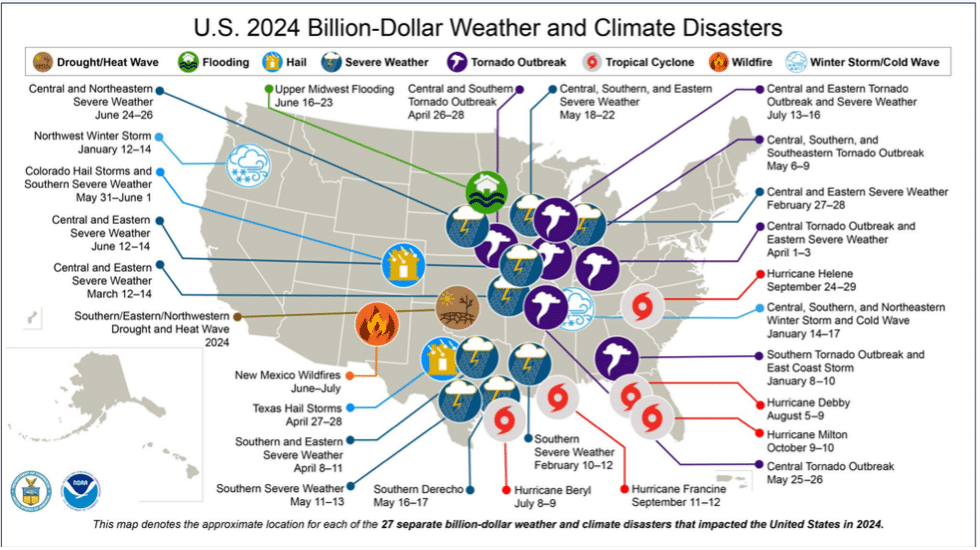
Texas appears repeatedly on the map, including in connection with hail storms, severe weather events, and Hurricane Beryl. That concentration matters because it shows that Texas is not exposed to just one recurring hazard. Instead, the state faces multiple categories of loss within the same year. For insurers and reinsurers, that kind of repeated and varied exposure affects how risk is priced, particularly in regions already associated with elevated catastrophe activity.
The graphic below places that recent pattern in longer-term context by showing cumulative, inflation-adjusted billion-dollar weather and climate disaster losses by state from 1980 through 2024. Texas has recorded more than $300 billion in total losses over that period, placing it in the highest cost category on the map. Florida is the only other state in that same top tier. That matters because insurers and reinsurers look not only at recent events, but at a state’s long-term catastrophe history when making decisions about underwriting, pricing, reinsurance, and market participation.
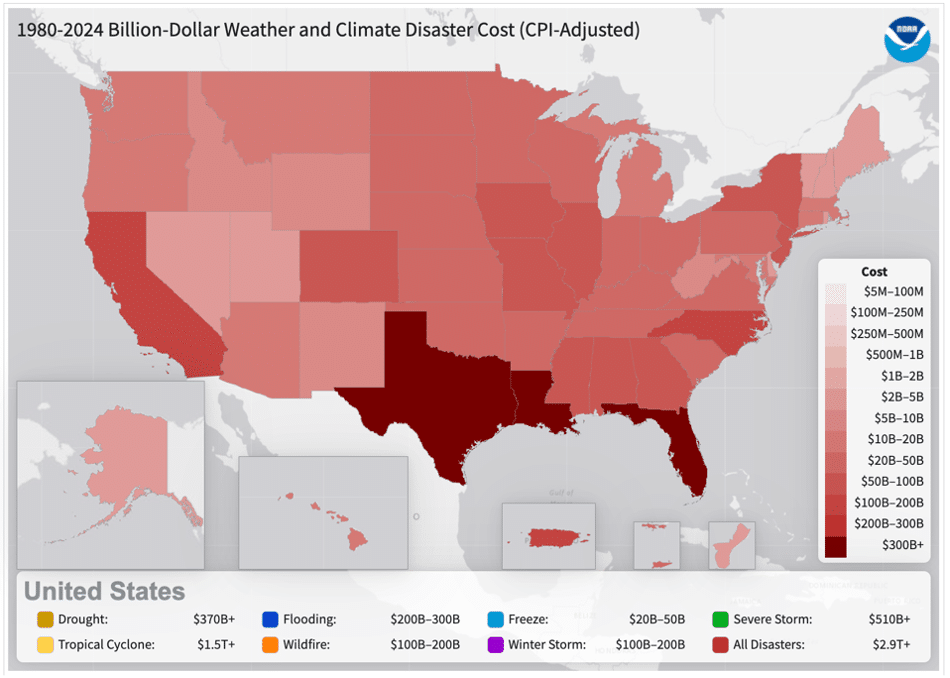
Together, these graphics show why the report’s findings are especially important for Texas. They capture both the frequency of recent major disaster events and the long-term scale of losses shaping the state’s insurance environment, with direct implications for deductibles, exclusions, underwriting assumptions, reinsurance costs, and the overall affordability and availability of coverage for affordable housing providers.
How Providers Are Managing Rising Insurance Costs
One of the report’s most useful contributions is its explanation of how rising insurance costs are affecting provider decision-making in real time. To stay afloat, many affordable housing owners and operators are making difficult tradeoffs, including:
- Taking on more risk by accepting higher deductibles or reduced coverage
- Effectively self-insuring smaller losses by avoiding claims
- Pooling risk and purchasing power with other properties or providers, with mixed results
- Absorbing costs elsewhere through deferred maintenance and reduced resident services
The report makes clear that these are not long-term solutions. In many cases, they simply shift the burden onto property operations, tenants, or future capital needs without addressing the underlying drivers of premium growth. Enterprise also notes that some providers have already closed, stopped producing new housing, or sold properties altogether, reducing affordable housing inventory at a time when it is urgently needed.
Potential Solutions Identified
This report also outlines a set of potential solutions at the provider, state, and federal levels, recognizing that no single strategy will be enough on its own. These policy solutions are generally aimed at three goals: bringing carriers back into markets they have abandoned or avoided, creating incentives for carriers to offer lower premiums through risk reduction or regulatory improvements, and promoting accountability and transparency in insurance pricing and coverage decisions.
Provider-Level Strategies
For providers, the report offers a practical toolkit focused on steps that can be taken at the property and portfolio level while broader reforms develop. These strategies include:
- improving understanding of actual and perceived risk exposure
- communicating more effectively with brokers and carriers
- documenting mitigation efforts more clearly
- making targeted property improvements that may reduce losses over time
Federal-Level Strategies
The report also identifies a federal role. It discusses how Congress, the Federal Housing Finance Agency, Fannie Mae, Freddie Mac, and the Federal Home Loan Banks may be able to support reforms, incentives, and other interventions, including possible backstops or subsidies tied to risk reduction.
State-Level Strategies
At the state level, the report points to a range of policy tools that could help stabilize the insurance market and reduce cost pressures for affordable housing. These strategies include:
- Tort reform and liability system changes. In states where litigation risk is contributing to insurance instability, the report identifies tort reform as one possible tool to improve predictability and encourage insurer participation.
- Aligning HFA and QAP policies with market conditions. The report points to a role for state housing finance agencies in better aligning underwriting, reserve requirements, and QAP incentives with current insurance realities, including support for resilience investments and more realistic operating assumptions.
- Support for insurance captives and risk pooling. The report points to insurance captives, pooled-risk models, and potentially government-backed reinsurance approaches as ways to help affordable housing providers stabilize coverage and spread risk more effectively.
- Premium relief through subsidies and tax incentives. The report also suggests states could explore premium subsidies or tax incentives tied to verified mitigation measures in order to lower costs while encouraging risk reduction.
- Fair access and anti-discrimination protections. The report also raises concerns about underwriting practices that may unfairly disadvantage affordable housing properties and suggests a role for stronger protections against discrimination and redlining.