
Written by Whitney Parra, TAAHP Senior Government Affairs Manager
The IRS has released the 2026 population figures that states must use to calculate both their Housing Credit ceiling and private activity bond volume cap.
For Texas, the new population figure is 31,709,821. Using the 2026 per-capita amounts already published by the IRS, this results in about $108.3 million in Housing Credit authority and a private activity bond cap of about $4.28 billion for 2026.
A significant milestone — and not just because of population growth
This year’s figures reflect two compounding factors: Texas’s continued population growth and the permanent 12 percent increase in state 9% Housing Credit allocation authority enacted through the One Big Beautiful Bill Act, signed into law on July 4, 2025.
After that legislation passed, the IRS updated its 2026 Housing Credit figures accordingly. The effective per-capita Housing Credit amount rises from $3.00 in 2025 to $3.42 in 2026 — the largest single-year per-capita increase in recent history.
Combined with population growth, this raises Texas’s total Housing Credit authority from approximately $93.9 million in 2025 to approximately $108.3 million in 2026, an increase of roughly $14.4 million, or 15.4 percent, before accounting for carryover or returned credits.
Texas Housing Credit authority: 2020–2026
Viewed over a longer horizon, the growth is substantial. Since 2020, Texas’s total Housing Credit authority has increased from $81.6 million to $108.3 million — a 32.8 percent increase over six years. The 2026 jump is the largest in the series, reflecting both continued population growth and the new federal expansion of Housing Credit authority.
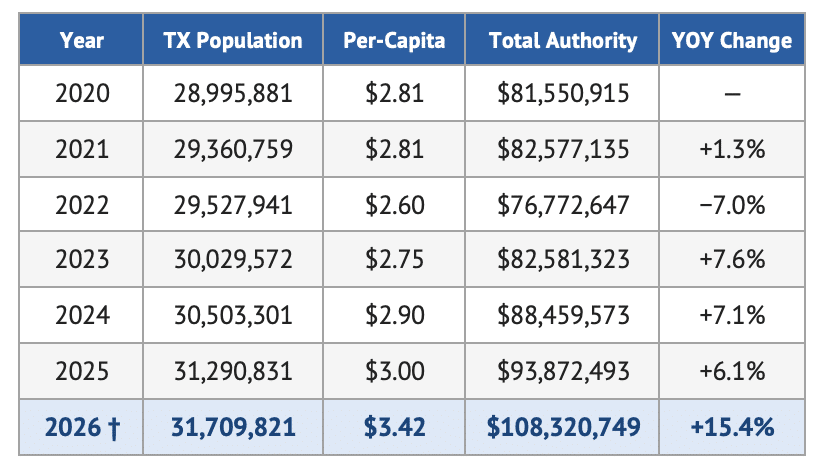
† 2026 reflects the permanent 12% per-capita increase enacted under the One Big Beautiful Bill Act (H.R. 1).
Is Texas positioned to maximize this investment?
Expanded federal authority does not automatically translate into more affordable housing units. That outcome depends on whether state policy enables developments of sufficient scale to convert credit dollars into housing efficiently. At present, a key structural constraint limits Texas’s ability to do so.
The $2 million per-development Housing Credit cap — set in 2011 through Senate Bill 1 and codified in Texas Government Code Section 2306.6711(b) — has not kept pace with construction cost increases. When the cap was established, a $2 million Housing Credit award could support a development of 180 units, as demonstrated by a League City development funded that year. Today, the same award produces approximately half that number.
National LIHTC research consistently demonstrates that developments in the 100-to-200-unit range achieve greater cost efficiency and produce more units per dollar of credit invested. When projects are constrained below that threshold by an outdated cap, the effective return on public investment is reduced — fewer families are housed for the same level of federal resources.
TAAHP’s position and next steps
Earlier this year, TAAHP submitted a formal request to the House Committee on Intergovernmental Affairs asking the Committee to adopt the following as an interim charge:
Review how current state policy and TDHCA rules governing the 9% Housing Credit program affect Texas’s ability to fully leverage the expanded federal Housing Credit investment enacted under the One Big Beautiful Bill Act (H.R. 1). Evaluate whether current program design allows that expanded investment to produce the maximum feasible number of affordable housing units statewide.
Although the Committee did not include the charge in its final interim study list, TAAHP remains committed to this issue. The newly released IRS population figures — confirming Texas’s 2026 Housing Credit authority at $108.3 million, up more than 32 percent since 2020 — reinforce the urgency of the question.
Texas now has more Housing Credit authority than at any point in the program’s history. Whether that authority produces the maximum number of affordable homes depends on whether the Legislature is prepared to revisit a per-development cap that was established under fundamentally different cost conditions fourteen years ago.